How to Prevent Weed Buildup on Your Kayak Transducer: Simple Steps to Keep Your Fishfinder Clear
Introduction
Weed accumulation on a transducer can degrade sonar clarity, cause false echoes, and ultimately reduce catch rates. This guide teaches the reader how to install, protect, and maintain a kayak transducer so that aquatic vegetation does not interfere with fishfinder readings. One will understand why proper mounting, spray shielding, and routine cleaning are essential for consistent performance on both fresh and salt water outings.
The steps described are applicable to a wide range of kayak and SUP setups, and they incorporate specific tools that simplify each task. By following the instructions, an angler can expect clearer sonar images, longer equipment life, and fewer unexpected trips back to shore for troubleshooting.
What You'll Need
- Scotty Transducer Arm – $37.76, 4.6/5 rating
- Scotty #140 Transducer Arm – $33.99, 4.6/5 rating
- Seaworthy Stern Pad – $34.99, 4.6/5 rating
- Garmin Spray Shield – $28.89, 4.4/5 rating
- Universal Kayak Fish Finder Mount – $24.99, 4.1/5 rating
- Marine‑grade silicone sealant (optional)
- Soft cleaning brush
- Fresh water rinse container
Step 1: Choose the Optimal Mounting System
Before addressing weed, one must secure the transducer in a location that minimizes exposure to dense vegetation. The Scotty Transducer Arm provides a telescoping design that extends from 11.5 to 18 inches, allowing precise placement away from the hull’s turbulent flow. Its 360‑degree swivel ensures the transducer can be angled toward open water, reducing the chance of snagging weeds.
Key features that make this arm advantageous include high‑strength composite construction, corrosion resistance, and the included gear‑head adapter for attaching Scotty universal sounder mounts. At $37.76 and a 4.6‑star rating from nearly 3,000 reviewers, it offers a cost‑effective solution for anglers who demand durability.
If a slightly lower‑priced alternative is preferred, the Scotty #140 Transducer Arm delivers identical telescoping length and swivel capability for $33.99. It also includes a locking side/deck mount and slip disc for micro‑adjustments, making it a versatile option for both kayaks and stand‑up paddle boards.
Install the chosen arm onto a compatible Scotty post mount or directly onto a kayak’s gear track. Ensure the arm is fully tightened and that the slip disc is set to a neutral position before proceeding.
Step 2: Secure the Transducer with a Dedicated Mount
After the arm is in place, the transducer itself must be attached using a mount that resists vibration and maintains alignment. The Universal Kayak Fish Finder Mount offers a tool‑free, drill‑free installation that clamps onto the kayak’s gear track. Its adjustable 9–14 inch arm permits fine‑tuning of depth and angle, which is crucial for keeping the sonar face clear of surface weeds.
This mount is constructed from marine‑grade composite and stainless steel, guaranteeing resistance to saltwater corrosion. At $24.99 and a 4.1‑star rating, it provides professional‑level performance without the premium price tag.
To install, slide the mount base onto the gear track, lock it in place, and attach the transducer arm from the previous step. Verify that the transducer sits level and that the arm can swivel freely without contacting the hull.
Step 3: Install a Spray Shield to Reduce Water Turbulence
High‑speed paddling creates spray that can carry weed fragments directly onto the transducer surface. The Garmin Spray Shield is designed to deflect water away from compatible transducers, diminishing the amount of debris that adheres during a run.
Measuring 5.5 × 2.8 × 1.2 inches and weighing only 0.1 lb, the spray shield adds minimal drag while providing a protective barrier. Priced at $28.89 with a 4.4‑star rating, it represents a lightweight, affordable upgrade for any kayak angler.
Attach the shield to the transducer housing according to the manufacturer’s instructions, ensuring the vented side faces forward. This orientation channels water around the sonar face rather than directly onto it, helping to keep the surface free of weed buildup.
Step 4: Apply a Screwless Stern Pad for Additional Protection
Even with a spray shield, occasional contact with submerged vegetation is inevitable. The Seaworthy Stern Pad offers a screwless, adhesive‑free solution that creates a smooth, non‑abrasive surface for the transducer to rest against.
Its dimensions (4.5" × 3.5" × 0.75") are ideal for standard‑size transducers, and the kit includes three cable clips and an install kit that cures in 18 hours. Installation requires no drilling, preserving hull integrity and allowing the pad to be painted to match the kayak color.
At $34.99 and a 4.6‑star rating, the pad is a reliable method for reducing micro‑scratches that can trap algae and weed fragments. Apply the pad to the transducer’s mounting area, press firmly, and allow the cure time before returning to the water.
Step 5: Perform Routine Cleaning After Each Outing
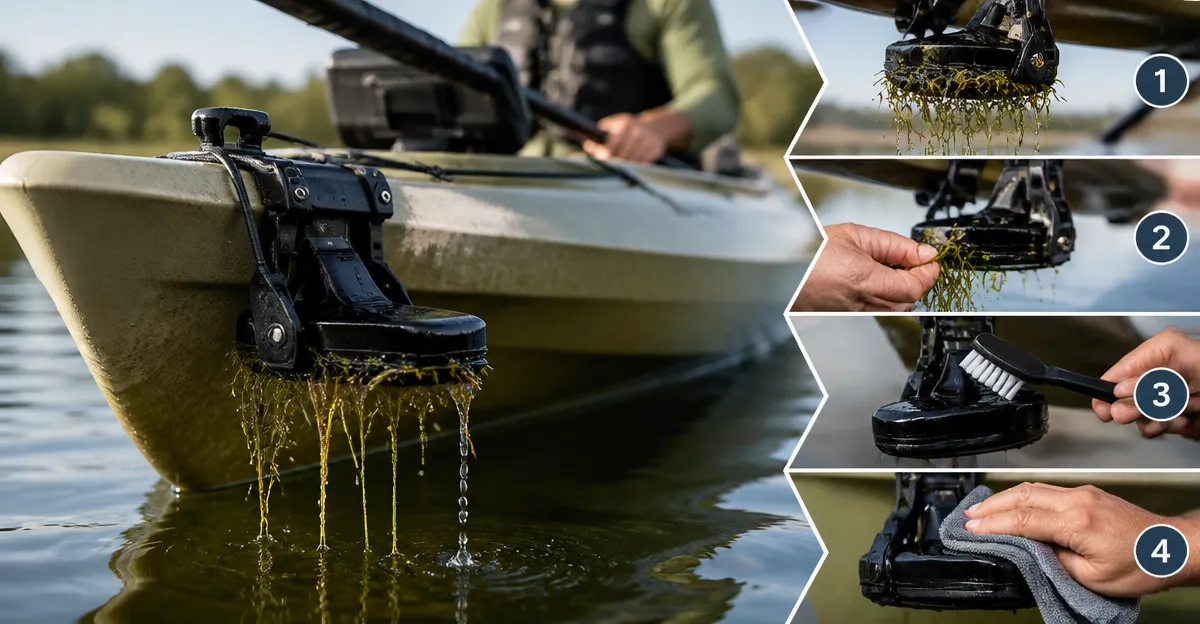
Regular maintenance is the most effective defense against weed buildup. After each fishing session, remove the transducer from the mount, rinse it with fresh water, and gently brush away any remaining plant material using a soft cleaning brush.
If stubborn algae persist, apply a thin layer of marine‑grade silicone sealant around the transducer housing to create a water‑repellent barrier. This step is optional but can extend the interval between deep cleanings.
Re‑attach the spray shield, stern pad, and mount components, then verify that the arm is locked in the desired position. Conduct a brief sonar test on open water to confirm clear imaging before heading back to the fishing area.
Tips & Pro Tips
- Mount the transducer on the farthest possible extension of the arm to keep it away from hull turbulence, which often carries weed.
- When paddling in heavy weed beds, angle the transducer slightly upward to avoid direct contact with floating vegetation.
- Periodically inspect slip discs on the Scotty arms; they can become clogged with debris, reducing micro‑adjustment precision.
- Store the spray shield in a protective pouch when not in use to prevent scratches.
- For saltwater environments, rinse all components with fresh water after each outing to prevent corrosion.
Troubleshooting
Problem: Sonar displays fuzzy or intermittent readings.
Solution: Check that the transducer face is free of weed and algae. If the spray shield is misaligned, reposition it so water flows around rather than onto the face. Verify that the arm is not bent or overtightened, which could distort the transducer angle.
Problem: Mount feels loose after several trips.
Solution: Re‑tighten the gear‑head adapter on the Scotty arm and ensure the slip disc is locked. If the Stern Pad shows signs of wear, replace it with a new pad to maintain a stable mounting surface.
Conclusion
By selecting the appropriate mounting arm, securing the transducer with a versatile mount, adding a spray shield, and protecting the housing with a screwless stern pad, one can dramatically reduce weed buildup on kayak transducers. Consistent cleaning and periodic inspection complete the maintenance cycle, ensuring that the fishfinder delivers crisp, reliable sonar data on every outing.
Implement these steps, and anglers will experience fewer false echoes, longer equipment life, and more successful catches.
Frequently Asked Questions
Why does weed buildup affect my kayak transducer performance?
Weeds cling to the transducer surface, scattering sonar waves and creating false echoes that blur fishfinder images.
How often should I clean my kayak transducer to prevent vegetation?
Inspect and rinse the transducer after each outing, and give it a thorough cleaning at least weekly in heavy weed areas.
What mounting techniques reduce weed accumulation on the transducer?
Mount the transducer on a low‑profile arm angled downward and keep it clear of the hull’s waterline where weeds collect.
Are there protective accessories that help keep weeds off the transducer?
Yes, spray shields, silicone covers, and dedicated transducer arms (e.g., Scotty Transducer Arm) deflect vegetation and debris.
Can I use the same prevention steps in both fresh and saltwater environments?
The cleaning and shielding methods are identical; just rinse with fresh water after saltwater use to remove salt residue.